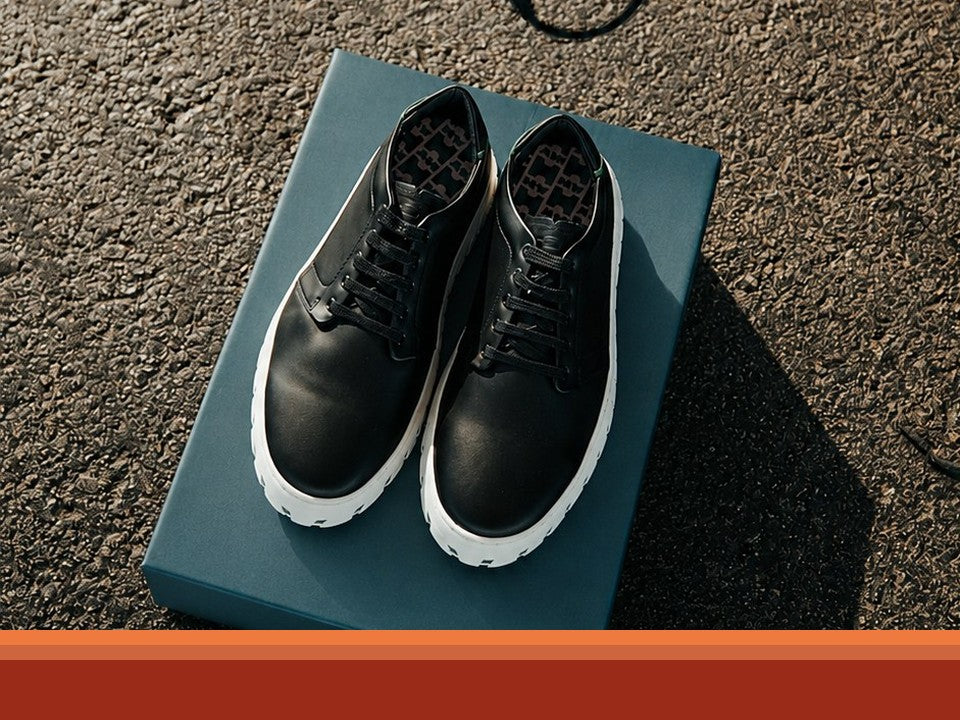
You bought those Allen Edmonds without checking the price tag. The Ferragamos too. When you need professional footwear, you buy quality and move on.
But around 2 PM, when the foot fatigue kicks in during your third meeting, price becomes irrelevant. The $700 you spent can’t buy you comfort through the rest of the day.
That’s the real fallacy: Thinking that higher prices solve fit problems. They don’t.
IAMBIC® makes precision-fit, award-winning shoes, each built on a last based on your own measurements. The MODEL T starts where price stops helping, with the shape of your foot.
Key takeaways
- A 2018 review in the Journal of Foot and Ankle Research, co-authored by Dr. Hylton Menz of La Trobe University, now IAMBIC’s Scientific Advisor, found that 63 to 72% of the people studied wore shoes that did not fit the length or width of their feet.
- Width is one dimension of fit. Volume, arch placement and heel-to-forefoot proportions go unaddressed by standard sizing at any price.
- Poor fit sets off compensations through your gait, muscles and posture, so fatigue builds by mid-afternoon.
- Leather softens with wear but cannot change the geometry of the last it was built on.
- IAMBIC builds each MODEL T from your smartphone scan and questionnaire, which together capture 20 biometric variables.
- The MODEL T was named a TIME Best Invention and is handcrafted in Portugal from Italian full-grain leather.
A half-day shoe costs more than its price
A shoe you remove the moment you get in your car is a morning-only solution, a $700 shoe that abandons you when you need it most. The conference where you skip evening networking because your feet hurt costs more than any price difference.
The most expensive shoes you own are the ones limiting your endurance.

The 63% problem: Most adults wear shoes that don’t fit
Research from La Trobe University exposed something the luxury footwear industry doesn’t advertise: 63 to 72% of the people studied wore incorrectly fitted shoes.
The geometric mismatch between mass-produced lasts and actual foot shapes affects everyone, regardless of price point. Allen Edmonds offers widths from AAAA to EEE, more than most. But width is one dimension. Volume, arch placement, heel-to-forefoot proportions: None of these variations get addressed.
The prestigious brands perfected everything except the one variable that matters most: Individual foot geometry. They’re selling beautiful solutions to an average foot that doesn’t exist.
The cascading effect: How poor fit drains the afternoon
Poor fit creates cascading compensations. Your gait adjusts to avoid pressure points. That adjustment stresses different muscles. Those muscles fatigue faster. That fatigue affects posture. Changed posture impacts presence.
By 3 PM, foot discomfort is only part of it. Your entire kinetic chain has been compensating since morning. The mental energy spent managing that discomfort is energy not spent on strategic thinking.
The pattern is consistent: Morning performance degrading to afternoon management. The work stays the same. The foundation, literally, isn’t stable.
Why breaking them in is acceptance of compromise
The luxury footwear industry has normalized a bizarre expectation: You should endure weeks of discomfort while expensive leather hopefully molds to your feet.
But leather can only stretch so far. If your forefoot is wider than the last allows, no amount of break-in changes the fundamental geometry. If your heel is narrower than standard, the slip won’t improve with time.
Call it breaking in the shoe. What actually breaks down is your standard for what comfortable professional footwear should feel like.
A shoe built on a last based on your own measurements starts close. The MODEL T still needs breaking in: Its Italian full-grain leather molds further to your foot over the first weeks of wear, around the shape the last already set. The founders cover how to wear and break in the MODEL T.
The precision difference: Shoes built from your measurements
IAMBIC uses your smartphone scan and questionnaire to capture your actual geometry, including volume and arch placement, across 20 biometric variables. Then it builds each shoe around that specific data.
When the shoe matches your actual architecture, the compromises disappear. Full days become possible again. Mental bandwidth stays focused on the work.
The technology eliminates the guesswork. No hoping the leather stretches correctly. No adapting your gait to accommodate the shoe. The fit is engineered from the start to match how your foot actually works.
In the IAMBIC app, NASA-grade computer vision analyzes 3 photos of each foot, and a short questionnaire covers how you like your shoes to feel. Each pair is handcrafted in Portugal from Italian full-grain leather and delivered in about 4 weeks. Photos of your worn pair, uploaded in the app as your Sole Print™, inform the last for your next one. The step-by-step process is in Fit Process 101, and the measurement system is on the technology page.
The fit paradox of premium footwear
The more you pay for traditional luxury shoes, the less likely they are to accommodate non-standard feet. European luxury brands use narrow, elegant lasts that photograph beautifully but fit a shrinking percentage of actual feet.
American heritage brands offer more width options, but width is only one dimension of fit. Your E-width foot might still have a narrow heel, high instep, or longer toe proportion that no standard last addresses.
Premium materials and expert craftsmanship can’t overcome fundamental geometric incompatibility.
| $700 off-the-rack shoe | $600 MODEL T | |
|---|---|---|
| The last | One standard last for every wearer in a size | A last based on your own measurements |
| What sets the fit | A size number and, at some brands, a width letter | Your scan and questionnaire, 20 biometric variables |
| If the fit is wrong | Return it or live with it | Signature Fit Guarantee, with refits until the fit is right |
| Your next pair | Built on the same last | Informed by photos of your worn pair |
When custom makes sense, and when it doesn’t
If standard luxury sizing works for you all day, and is more than tolerable, custom fit might be unnecessary complexity. Some feet do match traditional lasts well enough.
But if you’ve accumulated a collection of beautiful shoes you rarely wear for full days, the pattern is telling you something. Finding the right brand won’t fix it. Mass-produced geometry, however expertly crafted, might not match your individual architecture.
Forget whether you can afford custom fit. Ask whether you can afford another year of compromised performance during critical professional moments.
Beyond the transaction: Measure consistency
The real measure of shoe value is consistency of performance across all professional contexts, more than cost divided by wears. One pair that works everywhere beats three pairs with limited use cases.
Stop calculating cost per wear. Start measuring performance consistency. That’s the ROI that actually impacts executive effectiveness.
IAMBIC is not a medical device and does not diagnose or treat any condition.
See what a last built from your own measurements feels like
The MODEL T shoe is HSA/FSA eligible and covered by the Signature Fit Guarantee.
FAQs
How do you calculate cost per wear for shoes?
Divide the price of a pair by the number of times you wear it. A pair you change out of by mid-afternoon has done half a day’s work each time, so fit moves the result more than the price tag does.
Do more expensive shoes fit better?
Not reliably. Price buys materials and construction, while fit comes from the last, and most premium brands still build every pair in a size on one shared last.
Do IAMBIC shoes come in wide widths?
There is no width to choose. Each MODEL T is built on a last based on your own measurements, so your width is measured along with your length, arch and instep.
Helpful links
Sources
- Buldt AK, Menz HB (2018). Incorrectly fitted footwear, foot pain and foot disorders: A systematic search and narrative review of the literature. Journal of Foot and Ankle Research, 11:43.
- La Trobe University. Professor Hylton Menz.